Blinq: Digital Business Card
- 4.8
- Rating
- 1.00M
- Installs
- Free
- Price

 Analysis by App-foxy
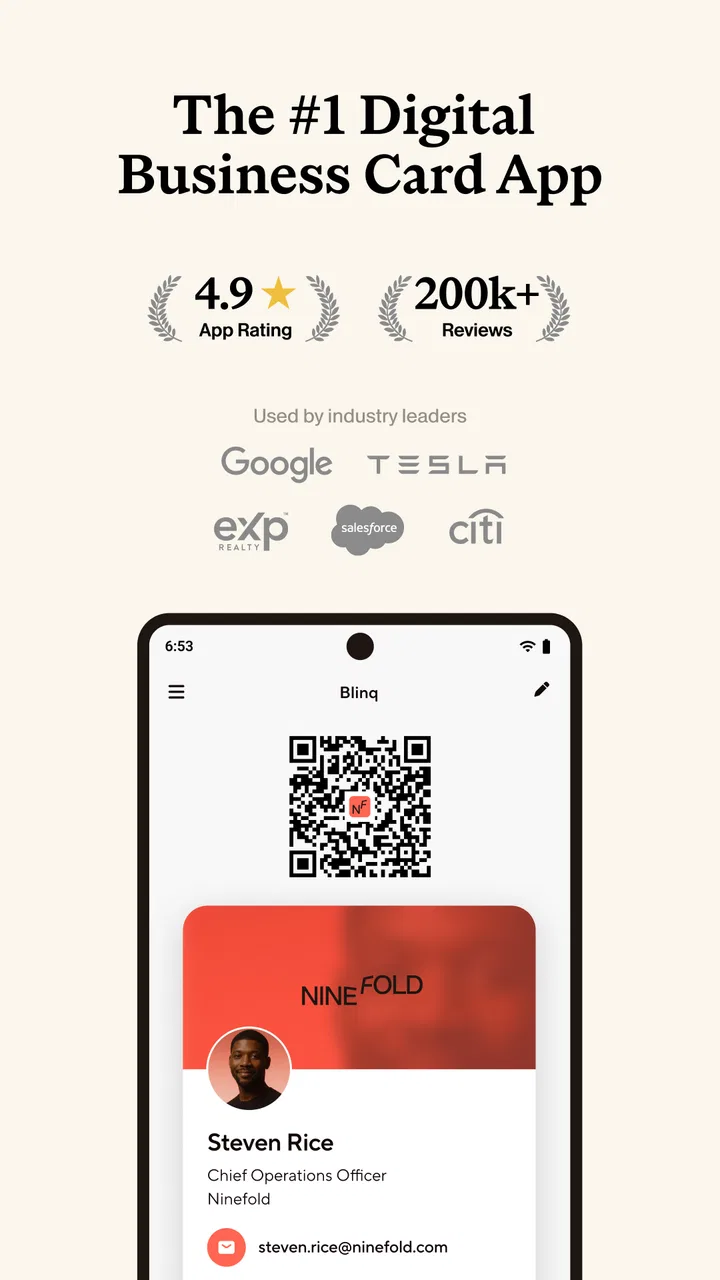
Meeting someone new often ends with the same small problem: I have their details in front of me, but my own contact information is buried in my phone, printed on an old card, or awkward to type out. Blinq: Digital Business Card takes a much simpler approach. It turns the exchange into a digital handoff, so I can present one professional identity without carrying a stack of paper cards.
After spending time with it, I see why this Business app has attracted such a strong audience. Developed by Blinq Technologies, it is free to start, rated for Everyone, and has built an average rating of 4.9 from around 26 thousand ratings. It has also passed 500 thousand installs, which suggests that the idea is useful beyond a small group of early adopters. The important question, though, is not whether a digital card feels impressive during the first meeting. It is whether I still want to use it after the novelty wears off.
What the first week feels like
The initial appeal is immediate because the app addresses a familiar social moment rather than asking me to learn an entirely new workflow. Instead of explaining where to find my phone number, email address, job title, or other professional details, I can share a single digital profile. That makes the first introduction feel cleaner, especially when the other person is also using a phone and does not want to manually copy information.
You May Also Like

 Blood Strike: 2.5 Anniversary
Blood Strike’s Loadouts Turn Every Drop Into a Tactical Gamble
A close look at Blood Strike’s custom loadouts: how fast access to signature weapons reshapes its battle royale rhythm, rewards preparation, and narrows the gap between fights.

 Pandora - Music & Podcasts
Pandora’s Music Is Easy to Start, but Harder to Recover
Pandora’s strength is its low-effort path from a seed to a station. Its weak spot is how much confidence it asks you to place in connection, setup, and quiet recovery.

 8 Ball Pool
 Is Built on Rivalries, Rematches, and Routine
A close look at the rivalries, rematches, shared routines, and unanswered safety questions that turn a quick pool match into a persistent mobile community.

 Samsung Music
’s Quiet Strength Is Playing What You Already Own
Its reach comes less from spectacle than from dependable access to a personal library. That simplicity is both the app’s strongest retention engine and its ceiling.

 AccuWeather: Weather Radar
AccuWeather Review: A Quick, Clear Forecast for Everyday Decisions
For everyday plans, the best forecast is the one you can understand quickly. AccuWeather makes rain timing, radar, and local conditions easy to act on, with a few trade-offs.

 Hill Climb Racing
Why Hill Climb Racing Still Turns Crashes Into One More Run
A tiny car, a bumpy hill and one more upgrade: Hill Climb Racing keeps resurfacing because its simple chaos makes every near-miss feel personal.
More From Our News Desk



I found the strongest use case in situations where I meet different kinds of contacts in a short period. A networking event, a client visit, a conference conversation, or even a casual introduction can all lead to the same exchange. A paper card is easy to lose, while a typed message can look improvised. A digital business card gives the interaction a consistent center, and that consistency is more valuable than the novelty of the format itself.
The app also suits people who do not want their professional identity tied to one physical workplace. Freelancers, consultants, salespeople, recruiters, creators, and small-business owners may meet contacts in offices, cafés, shared workspaces, or online conversations. Carrying a card in a wallet does not help much when the meeting happens through a video call or when someone asks for details unexpectedly. A digital profile is easier to keep available across those moments.
One practical tip is to treat the card as a landing point rather than a complete biography. I would keep the opening information focused on the details a new contact actually needs first: who I am, what I do, and how to continue the conversation. If the card becomes crowded with every possible link and description, the recipient has to search for the useful part. The best experience comes from making the next action obvious.
This is where Blinq feels different from simply sending a contact file. A contact file is useful when someone wants to save a number immediately, but it is not always a good introduction. A social profile may show more personality, yet it can mix personal and professional information. A traditional paper card is familiar and works without a phone, but it requires printing, carrying, and replacing. The digital card sits between those options: more structured than a message and more adaptable than paper.
The first week can therefore feel unusually smooth. I do not need to remember which pocket contains my cards, and I avoid the little pause where I search through contacts to find the right information. That convenience is real. Still, first impressions can be misleading. A card that looks polished on day one can become less useful if I never update it or if recipients find the sharing process less natural than I do.
Where it fits into an everyday routine
Imagine arriving at a local business meeting after changing roles recently. My old printed cards still show outdated information, and ordering a new batch would make sense only if I were certain the details would remain stable. With a digital card, I can share the current version during the meeting and avoid handing out something that already needs correcting. That is a small scenario, but it captures the lasting advantage: the identity I share can remain aligned with the identity I actually use.
Another useful situation is a professional who has several ways to be contacted. A phone call may be appropriate for one person, email for another, and a social or portfolio channel for someone else. Instead of deciding which single detail to send, I can present a focused set of options and let the recipient choose. The trade-off is that I must decide which channels deserve space. The app can organize the handoff, but it cannot make an unfocused professional presence feel focused.
I would be less enthusiastic for someone who almost never meets new professional contacts or who works entirely through an established company directory. If colleagues and clients already have a reliable way to reach me, adding another identity layer may create more upkeep than value. The app is most convincing when the user repeatedly introduces themselves to people who are not already in their network.
Why the value can last beyond the novelty
The recurring value comes from reducing small bits of friction. A paper card must be printed before it can be shared. A typed message must be composed each time. A phone contact may contain the right number but not the context that explains who I am. A dedicated digital card gives me one professional starting point that can be reused whenever a new conversation begins.
That reuse matters more than the visual appeal. The first few exchanges may feel modern because the format is different, but the lasting benefit is practical: I can make the same introduction without recreating it. For a person who attends events regularly, takes client calls, or changes projects often, that can become a dependable habit rather than a one-time trick.
I also like the idea of separating the act of sharing from the act of saving. When I hand someone paper, I have little control over what happens next. When I send a message with a few details, the recipient may need to save them manually. A digital card gives the recipient a clearer reference point for the relationship. That does not guarantee they will follow up, of course, but it makes my side of the exchange more organized.
There is a subtle benefit for people who maintain more than one professional role. A single printed card can force a compromise: one title, one organization, and one set of contact details. A digital format is better suited to a changing working life because it can be adjusted when a project, role, or contact preference changes. I would still avoid creating a separate identity for every minor activity. Too many versions can confuse both me and the people receiving them.
The app’s free price makes experimentation easy. I can test whether digital introductions fit my routine without first buying printed materials. At the same time, in-app purchases range from $9.99 to $87.99 per item, so I would pay attention before selecting anything beyond the free experience. The presence of paid items does not cancel out the usefulness of the free starting point, but it does mean that long-term users should understand which extras they genuinely need instead of assuming every available option is essential.
How it compares with familiar alternatives
Compared with paper cards, Blinq is more convenient when information changes and more suitable for remote conversations. Paper still has two advantages: it works without a battery or screen, and some people genuinely prefer a physical object after an in-person meeting. I would keep paper in the mix for formal environments where a tangible exchange is part of the expected etiquette, but I would not rely on it alone if my details change frequently.
Compared with sending a text message, the digital card feels more intentional. A message can be warmer for an existing relationship, but it is easy to write inconsistently or forget an important detail. The card provides a repeatable format. The downside is that a recipient may prefer a direct message and may see a digital card as one more thing to open. That is why I would use it as an invitation to continue the conversation, not as a substitute for personal follow-up.
Compared with a full professional networking platform, the app is narrower and less socially demanding. I do not need to ask someone to join a network or maintain a public feed simply to share basic professional information. That simplicity is a strength for introductions. The limitation is equally clear: a card does not replace the discovery, messaging, or relationship tools of a full networking service. If my main goal is finding opportunities inside a large professional community, another category of app will serve me better.
The best approach is to choose the tool based on the moment. I would use Blinq when I need a controlled, professional introduction; a direct message when the conversation is already personal or active; paper when the setting strongly favors physical cards; and a broader networking platform when ongoing community participation matters more than a clean contact exchange.
Maintenance is the real test
A digital business card only stays useful if the information remains trustworthy. The maintenance burden is not necessarily large, but it is easy to underestimate. Every time my role, email address, phone number, employer, or preferred contact channel changes, I need to remember that the card is part of that public identity. An outdated digital card can be more awkward than an outdated paper card because I may continue sharing it without noticing.
I would build a simple review habit around natural career moments rather than checking constantly. When I change a job title, finish a major project, replace a phone number, or decide that one contact channel is no longer appropriate, I would immediately revisit the card. A quick check before a conference or a series of client meetings is also worthwhile. The goal is not frequent tinkering; it is preventing stale information from becoming the version strangers remember.
One non-obvious trade-off is that easy editing can encourage unnecessary editing. If I keep changing the wording, order, and presentation every few days, contacts may see inconsistent versions of me. Stability builds recognition. I would make the card clear first, then change only information that is genuinely outdated or a detail that repeatedly causes confusion.
Another useful habit is to test the card from the recipient’s perspective. I would open the shared version as if I were a new contact and ask whether the next step is obvious. Can I tell what this person does quickly? Is the preferred way to reach them clear? Does the profile still make sense outside the context of the conversation where it was shared? This check catches problems that are easy to miss while editing from the owner’s point of view.
The app is also not a replacement for contact management. A recipient may view the card and still forget to save the details. After an important meeting, I would follow up personally and record the relationship in the contact system I already use. The digital card improves the introduction, but the responsibility for remembering the person and continuing the conversation remains mine.
Where fatigue can appear
The main source of fatigue is not the concept; it is the possibility of turning every introduction into a small technology demonstration. If I pause to explain how the card works, ask someone to navigate an unfamiliar step, or insist on it when a simple exchange would be faster, the tool becomes a barrier. I would keep a fallback ready, such as saying my name aloud and sending the relevant details directly when the other person prefers that.
There can also be social fatigue around receiving links or profiles. People are cautious about opening unfamiliar destinations, especially when they are meeting many new contacts in one day. A polished digital card may still be ignored if the recipient is busy or does not want another item to process. The app can make my information available, but it cannot create attention or trust by itself.
Another limitation is dependence on the surrounding device and connection. A digital exchange is naturally less comfortable when a phone is nearly out of power, the environment is distracting, or the recipient is using a device that makes the interaction inconvenient. Paper has an undeniable resilience here. For high-stakes events, I would not treat a digital card as my only possible way to share information.
The paid layer can create a different kind of fatigue. Once I am comfortable with the basic workflow, I may be tempted to add extras simply because they are available. Since individual in-app purchases can reach $87.99, I would decide based on a recurring need rather than curiosity. If the free setup already handles my introductions, spending more may not improve the outcome enough to justify the cost.
I would also skip the app if my professional identity is intentionally private or if I do not want strangers to have a convenient route to contact me. A digital card is designed to make sharing easier, and that is precisely why it may be unsuitable for people who need strict separation between public and private work. The right choice depends not only on convenience but also on how broadly I want my details distributed.
Does it earn a permanent place?
For me, Blinq earns lasting space when introductions are a regular part of work. Its strongest quality is not that it makes a meeting feel futuristic. It is that it gives a changing professional identity a reusable home, reducing the need to print, rewrite, or search for details every time a new contact appears.
The app is especially appealing to freelancers, independent professionals, mobile workers, and people who attend networking events. It is also a sensible experiment for anyone whose printed cards are frequently outdated. The free entry point lowers the risk of trying it, while the Everyone age rating makes it broadly approachable. Its popularity, including an average rating of 4.9 and more than 500 thousand installs, supports the impression that the basic idea resonates with many users, though popularity alone does not remove the need to maintain the card carefully.
I would not recommend making it the center of an entire relationship-building system. It is an introduction tool, not a substitute for thoughtful follow-up, a contact database, or a professional community. I would also keep paper or direct messaging available for people who find digital sharing impersonal or inconvenient. The best results come from treating the app as one reliable option rather than forcing every contact into the same workflow.
My final view is positive but practical. Blinq is worth keeping when it becomes part of a repeated introduction habit, not merely a novelty shown once. Set it up with only the information a new contact needs, check it when your professional details change, test the recipient experience occasionally, and avoid paying for extras unless they solve a problem you actually face. Used that way, the app has a clear role: it keeps a professional introduction current, portable, and easier to share than the usual alternatives.
For someone who meets new contacts only rarely, a direct message or a small supply of paper cards may be simpler. For everyone whose work depends on being remembered after a brief conversation, I think Blinq: Digital Business Card has enough recurring value to stay installed long after the first-week appeal fades.
FAQs for Blinq: Digital Business Card
01What is Blinq: Digital Business Card?
Blinq is a digital business card application that allows users to create and share professional contact information seamlessly. The app offers customizable templates and integrates with various platforms, making it easy to share your digital card via QR codes, email, or social media. It's designed for professionals who want a modern approach to networking.
02How does Blinq ensure my data is secure?
Blinq prioritizes user security by implementing robust encryption protocols and privacy measures. The app ensures that your data is stored securely and only shared with your permission. Additionally, Blinq provides users with control over what information is visible, allowing you to customize privacy settings according to your preferences.
03Is Blinq compatible with all devices and platforms?
Yes, Blinq is designed to be universally compatible. It works on both Android and iOS devices and can integrate with popular platforms like LinkedIn, WhatsApp, and email clients. The app also supports sharing via QR codes, ensuring that your digital card can be easily accessed by anyone, regardless of their device.
04Are there any costs associated with using Blinq?
Blinq offers both free and premium versions of the app. The free version provides basic features for creating and sharing digital business cards. The premium version includes advanced customization options, analytics, and additional integrations. Users can choose the plan that best suits their needs, with flexible pricing options for the premium features.
05Can I customize my digital business card in Blinq?
Absolutely! Blinq offers a wide range of customization options, allowing users to personalize their digital business cards. You can choose from various templates, colors, and fonts to match your brand identity. Additionally, Blinq supports adding multimedia elements like videos and images, providing a comprehensive way to showcase your professional profile.
Pros
- Seamlessly integrates with other apps.
- Customizable card designs available.
- Supports multiple profiles per user.
- Environmentally friendly option.
- Easy to share via QR code.
Cons
- Limited offline functionality.
- Premium features behind a paywall.
- Occasional syncing issues reported.
- Requires internet connection for updates.
- Limited support for older devices.

Blinq: Digital Business Card
Gallery